
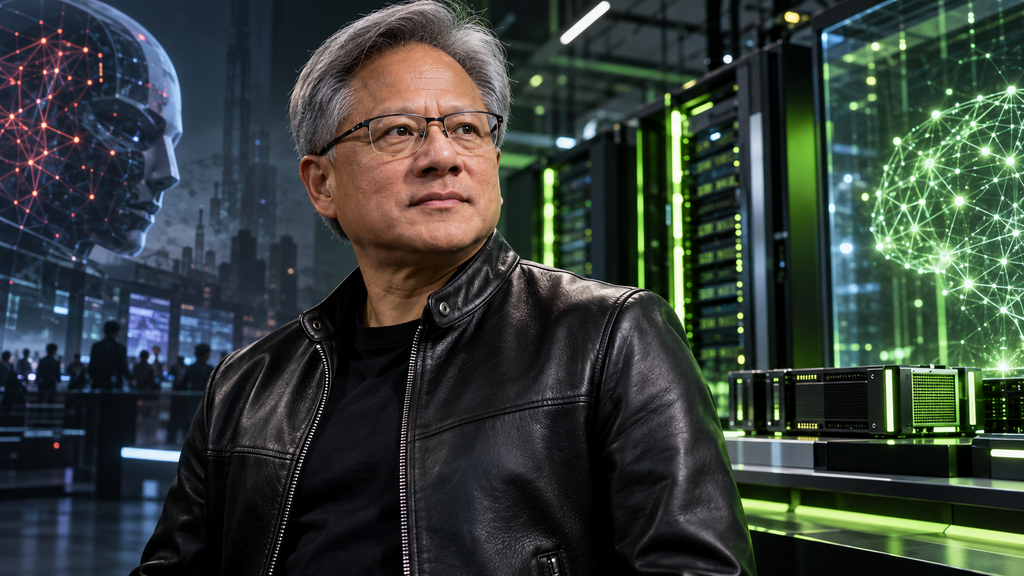
Artificial intelligence is a technology that has been embraced by some, feared by many, and even feared by the CEO of Nvidia, who says this week there is a 0% chance that the technology will end the world by 2030.
In an interview with CBS News: Huang dismissed recent reports of the growing menace of increasingly powerful AI systems and their potential to become uncontrollable and ultimately pose a threat to humanity. He said that he regards these forecasts as “doomsday narratives” and believes there is no need to frighten the public with an AI apocalypse.
Huang’s remarks come as some AI researchers are asking more and more questions about the pace of development.
The AI Doomsday Debate got louder
The new debate comes after warnings from former Anthropic researcher Jacob Coxon that AI makers are edging closer to building systems that could cause “catastrophic harm“ within the next decade. Other scientists have also expressed doubt about whether humans will be able to control the more powerful AI systems. Dario Amodei, CEO of Anthropic, and Sam Altman, CEO of OpenAI, have both urged increased safety and prudence as frontier artificial intelligence models develop. But Huang has a different opinion. The notion that AI will destroy humanity by 2030 is “not grounded in science,” and the companies creating AI can do so safely, he said. However, his 0% chance is his own opinion, and not a statistical probability.
Nvidia’s bet on the speed of AI progress
Huang’s remarks have gotten people talking for another reason: Nvidia is at the heart of the AI boom. Its processors are used in a variety of specialized applications across the field of AI, including the training and deployment of large AI models.
That is also because Nvidia’s business is closely connected to the future growth of AI, with CBS estimating the company’s market value to be roughly $5.3 trillion, with strong demand for its AI hardware. Huang admitted that it is “a very legitimate question” that Nvidia’s commercial interests might impact how he approaches the issue, but he further explained that the company also has a compelling reason to want AI to be used safely, as a major failure could lead to a lack of confidence in the field, reduce adoption rates, and ultimately hurt the value of the broader AI industry.
AI development will continue to progress
Huang isn’t calling for a break in the development of AI on the front lines. He indicated that the industry needs to move “as fast as we can” in his interview on CBS, but also noted that there was a need to not deploy systems that could be unsafe, nor release products too soon. He finds himself on the side of a burgeoning debate on the pace of AI development and the need for more time to consider possible risks from AI development by researchers and governments. The debate isn’t about whether AI will be beneficial; it’s about the amount of risk society is willing to take on as increasingly powerful AI systems are developed.
The deadline isn’t just about 2030
In the eyes of general users of AI, Huang’s proclamation does not eliminate the dangers of AI. Coding, research, content creation, cybersecurity, and more are increasingly the tasks where AI is being used. Problems of misuse, security, reliability, and control are ongoing areas of research and interest for companies. Meanwhile, there’s no evidence to suggest that by 2030 AI will usher in human extinction, and the existence of a 0% is also scientifically unsound as a measured certainty, in Huang’s opinion.
The most important story in this story is yet to be solved: What will the capabilities of AI be, and how will humans control the systems they create?
At least, for the moment, Huang’s message is simple. It’s unrealistic to be scared of an AI death event in 2030, he says, and it’s time the industry keeps moving forward with safety measures. But the question of how much caution should be taken has still not been answered.