Table of Contents
- The Real Difference Starts When You Put Them to Work
- The First Five Minutes Tell You a Lot
- Where Both Stand in Comparison
- The Features That Actually Matter for SEO
- Choosing Between Them for Different SEO Jobs
- So, Which One Fits an SEO Professional?
- The Real SEO Advantage Isn’t the AI
- Conclusion
- FAQs About ChatGPT vs Gemini for SEO
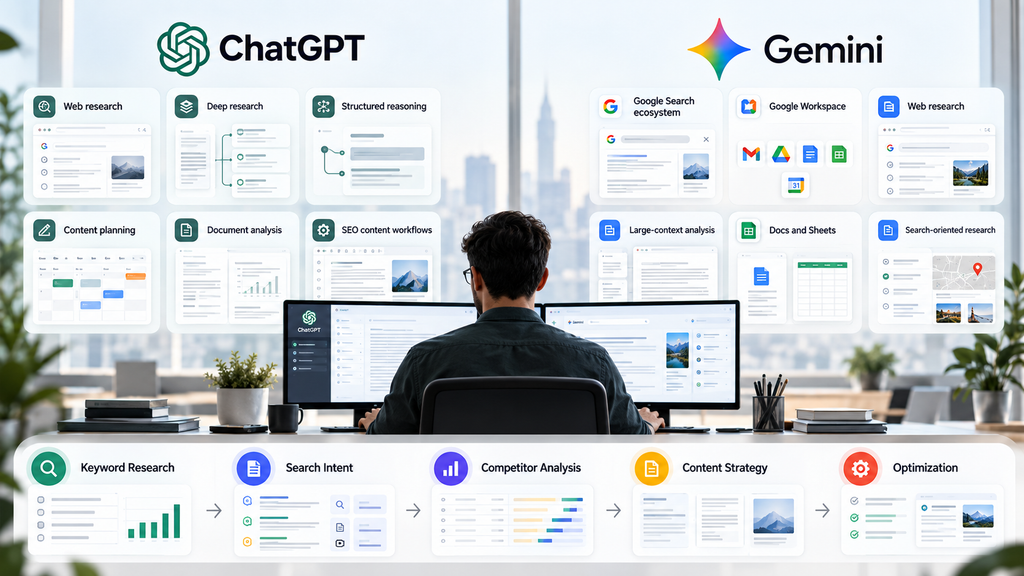
Imagine AI assistance helps you with SEO, and you are creating your next blog post; this is not just a regular post, but together you are changing the methods you used in the past for keyword research, competitor analysis, and content planning. Both ChatGPT and Gemini can manage these tasks, albeit in different ways when it comes to SEO. ChatGPT integrates web searches, Deep Research, analysis, and content strategies within a single workflow, whereas Gemini has a tight interlinkage with Google’s search and productivity environment.
That makes the real question more interesting than simply asking which AI writes better: which one actually fits the way you do SEO? Let’s break down the differences and see where ChatGPT and Gemini each make the biggest impact.
The Real Difference Starts When You Put Them to Work
At a basic level, ChatGPT and Gemini can perform many of the same SEO tasks:
- Generate content ideas
- Build outlines
- Rewrite content
- Analyze keywords
- Summarize research
- Create title and meta-description ideas
- Explain SEO concepts
- Analyze competitors
- Help with technical SEO
- Assist with content optimization
But their surrounding ecosystems are different.
ChatGPT is particularly useful when you want an AI research and reasoning partner that can combine web search, uploaded material, structured analysis, and writing in one workflow. OpenAI’s Deep Research is designed for multi-step research across the web and produces documented reports with citations.
Gemini, meanwhile, has a natural connection to Google’s search and productivity ecosystem. Google Search’s AI Mode uses Google’s web index and can break complicated questions into multiple related searches before assembling an answer.
The First Five Minutes Tell You a Lot
Imagine you are finding a new keyword:
“best AI tools for small businesses.”
An SEO professional might want to know:
- What search intent sits behind the keyword?
- What topics are competitors covering?
- Which questions are users asking?
- What entities should the article mention?
- Which subtopics are missing?
- What information needs current research?
ChatGPT: ChatGPT can turn this into a research workflow using Search and Deep Research. Its Deep Research feature is specifically designed to search, evaluate, and synthesize information from multiple sources rather than simply returning individual search results.
Gemini: Gemini can approach the same problem through Google’s search ecosystem. Google says AI Mode can use a technique called query fan-out, where a question is divided into related searches that are performed across multiple sources.
For an SEO professional, that difference matters.
You’re not simply asking an AI to “write an article.” You’re asking it to understand the search landscape around a topic.
Where Both Stand in Comparison
| ChatGPT for SEO | Gemini for SEO |
| Primary advantage: Combines research, file analysis, and content reasoning in one workflow. | Primary Advantage: Works in conjunction with Google Search and Google. |
| Research capabilities: Can work with uploaded files alongside web research. | Research capabilities: Google’s Deep Research can combine web information with content from connected Workspace applications. |
| Citations: ChatGPT’s Deep Research can produce documented analysis with citations. | Search references: Google AI Mode uses Search data and provides links to supporting web content. |
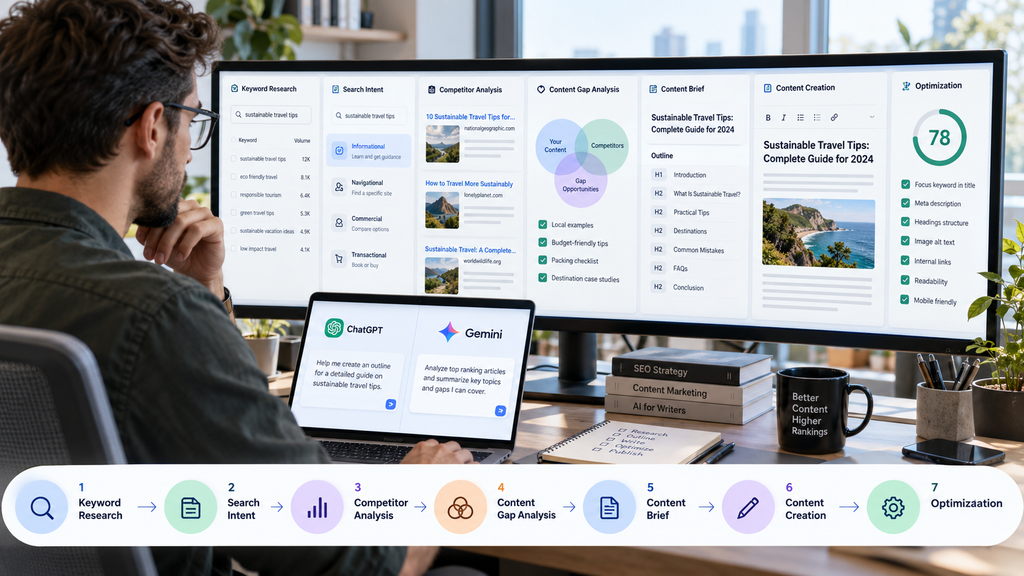
| Typical SEO workflow: Keyword research → Research → Content brief → Outline → Draft → Optimization. | Typical SEO workflow: Google Workspace files → Web research → Campaign planning → Content development. |
| Content organization: Can turn large amounts of notes into topical maps, content outlines, and competitor-content gap analyses. | Workspace organization: Can bring information from multiple Google applications into a more connected research workflow. |
| Main practical benefit: Transforms raw SEO research into structured content assets. | Main practical benefit: Reduces the need to move information between multiple Google applications. |
The Features That Actually Matter for SEO
| SEO Capability | ChatGPT | Gemini |
| Web research | Yes | Yes |
| Deep research | Yes | Yes |
| Content outlining | Strong | Strong |
| Keyword and topic analysis | Yes | Yes |
| Long-document analysis | Strong | Strong |
| Google Search integration | Web search available | Deeper integration with Google Search and AI Mode |
| Google Workspace integration | Available through connected apps or workflows, depending on the plan | Strong native integration with Google Workspace |
| Content optimization | Yes | Yes |
| Technical SEO assistance | Yes | Yes |
| Coding and data analysis | Yes | Yes |
| Search-result exploration | Web search | Google Search and AI Mode ecosystem |
Choosing Between Them for Different SEO Jobs
In developing a content strategy
ChatGPT can be useful when needing to research, review various sources, and pull everything together into a coherent research plan. Its Deep Research workflow is specifically geared to multi-step research and synthesis.
If you’re learning about the Google search space.
Gemini has an interesting ecosystem advantage because Google’s AI Mode is built directly around Google Search and its web index. Google says AI Mode can fan a question out into multiple related searches before assembling the response.
If you’re writing and optimizing content
Both can help with:
- Outlines
- Rewriting
- Search-intent analysis
- Content gaps
- FAQs
- Internal-link suggestions
- On-page optimization
If you’re working with large amounts of information
This is an area where Gemini deserves attention. Google currently documents context windows of up to 1 million tokens for Gemini Apps on AI Pro and AI Ultra plans, while access and limits vary by plan. That can be useful when SEO work involves very large documents, research collections, or lengthy project material. But context size isn’t the same thing as analysis quality. Being able to upload more information doesn’t automatically mean the resulting SEO strategy will be better.
So, Which One Fits an SEO Professional?
The answer depends heavily on the workflow.
ChatGPT may fit you better if you:
- Do extensive content research
- Work with multiple documents and sources
- Need structured analysis
- Build detailed content briefs
- Want an AI research partner
- Frequently move between research and writing
- Need flexible reasoning and data-analysis workflows
Gemini may fit you better if you:
- Spend much of your day inside Google products
- Work heavily with Google Workspace
- Want close integration with Google’s search ecosystem
- Handle very large documents or datasets
- Want to explore topics through Google’s AI-powered Search experiences
- Prefer keeping research and productivity work close to Google’s ecosystem
Use both:
An SEO professional doesn’t necessarily need to treat ChatGPT and Gemini as competing replacements. One can be used for research and analysis while the other handles a different part of the workflow. The key is whether the combination actually improves your process rather than simply adding another subscription.
The Real SEO Advantage Isn’t the AI
Unlike content developed for a greater number or variations of search results, Google’s new guidance for generative search is about creating unique and valuable content. Google recommends this method, concentrating on what visitors would discover beneficial and satisfying. This alters the way SEO professionals ought to utilize AI.
Don’t ask:
“So how is it that AI can generate 50 articles about SEO in just one month?”
Ask:
“How can I use AI to do research, understand, and then explain this in a more thorough and comprehensive way than I could before?”
ChatGPT and Gemini are capable of streamlining SEO tasks. The difference is not about who can make a nicer-looking paragraph; it is about which ecosystem it fits into for conducting research, analysis, creation, and measurement of content.
Conclusion
ChatGPT and Gemini can optimize the procedure for SEO; they can’t change the individuals and their experience, which are crucial to any SEO approach. On some tasks, ChatGPT will be helpful for conducting extensive research, breaking data down into ideas in a structured way, brainstorming content ideas or plans, or even turning raw data into actionable insights. The advantages of ChatGPT lie in its deep data analysis capabilities, the generation of a structured analysis, content planning, and the ability to translate raw data into actionable strategies, especially in tasks that closely align with the creation of content.
In the end, it is up to you to decide on the basis of how you conduct your research, build, review, and execute your SEO efforts. If you’re not able to decide which is the best AI overall, simply decide which one you feel best suited to spend the least amount of time with. AI can take care of much of the heavy lifting, allowing you to spend more time engaging with your audience, identifying actionable opportunities, developing content that resonates and assists, and ultimately making decisions on the path to take your strategy.
FAQs About ChatGPT vs Gemini for SEO
1. Is there any option to do keyword research using Gemini?
Yes. Gemini helps with organizing keywords by intent, topic, and content opportunity and can conduct research on topics via the Google web ecosystem. But keyword volume and ranking determination should take into account more than just AI estimation, but rather data from SEO.
2. Can ChatGPT + Gemini be employed by SEO professionals?
They can. When used together, this can make sense if they serve different aspects of a workflow, such as research + analysis in Google Workspace, or search-oriented workflows.