
What if you could provide AI with a goal, and after your next prompt, the AI decided on the steps and started working? AI agents are designed to follow the principle of “that is why they are called that”. An AI agent can do more than just answer questions; it can split up a task into smaller steps, use a variety of tools, make decisions, monitor the task, and even modify its actions as it goes. You’re not seeking out any solution from the AI; you’re asking it to do something.
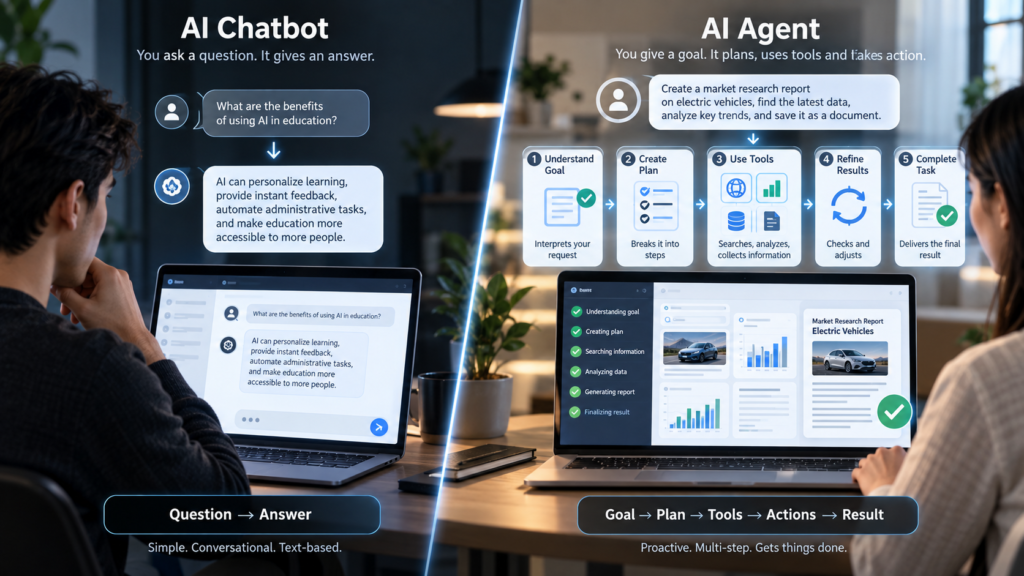
However, how does an AI agent actually make those decisions, what goes on in the background, and how is it different from the AI chatbots and automation that you already use? In this guide, we’ll take a deep dive into understanding the nature of AI agents, how they operate, what they can accomplish, and the areas in which they have room for improvement, and do it in a simple and comprehensible manner.
An AI Agent Doesn’t Just Answer—It Takes Action
An AI agent is a software program that can complete several actions, use tools, look for information, change its actions based on the information it finds, and so on to reach a goal of some kind. In contrast to a traditional business bot, which is able to answer only one query, an AI Agent can break down a general query into smaller parts and determine what to do next. For instance, you may have to ask an agent to review five documents, pinpoint business risks, compare that list with one created in a previous report, research information, organize the information, and make a final report.
Some AI agents might be able to execute tasks to a certain extent autonomously, by using reasoning, planning, memory, and potentially tool usage. But the terms chatbot, AI assistant, AI agent, and agentic AI are not always interchangeable, nor are the products that are sold as “agents” always the same. The concept is that the AI agent does not always have to take a certain action, but can choose what to do based on the current context.
Working of AI agents
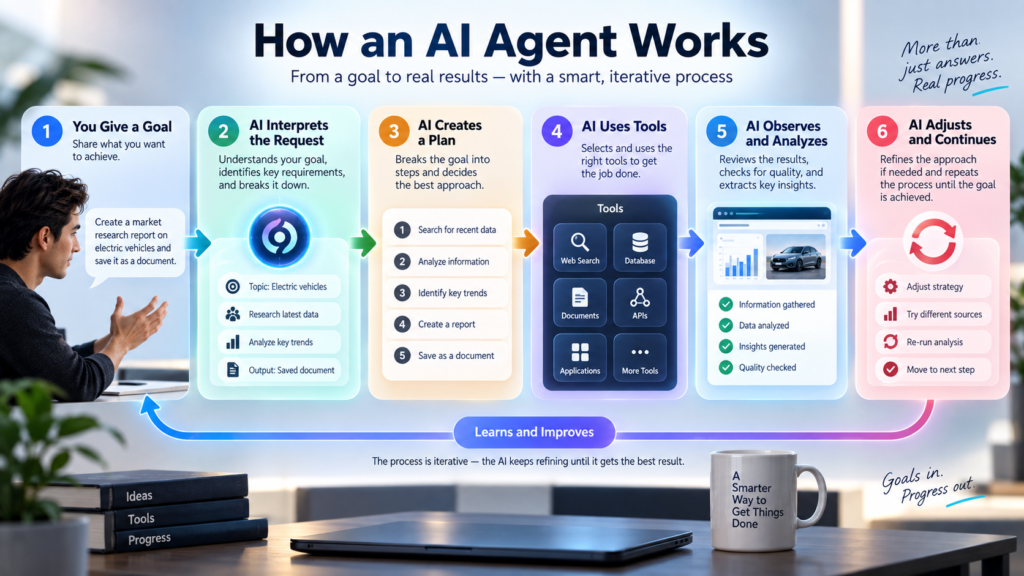
| Step | What happens | Example in the sales-data task |
| Step 1: You give it a goal | You provide the overall objective without describing every individual action. | “Analyze this month’s sales data and tell me which products need attention.” |
| Step 2: It interprets the task | The AI determines what the request means and identifies the information it may need. | It recognizes that it may need sales data, product information, and historical figures. |
| Step 3: It creates a plan | The agent decides which actions should happen next. As new information becomes available, the plan may change. | It will access the database, calculated data, and other information available for the creation of a summary. |
| Step 4: It uses a tool | The agent selects an appropriate tool and performs an action. This is what allows it to act rather than simply provide an answer. | It queries a database or retrieves a relevant document. |
| Step 5: It observes the result | The agent reviews the output from the tool and uses it to determine what to do next. | It receives the sales figures from the database and analyzes the available information. |
| Step 6: It adjusts its approach | The agent changes or extends its process when the information is incomplete or reveals something unexpected. | It performs another search if data is missing or investigates further if a calculation shows an unusual result. |
A real-world example: an AI research agent
You ask an AI agent:
“Analyze the latest developments in the field of electric vehicles and make a summary report about it.”
A basic chatbot might provide an answer based on the information available to its model. An agent could potentially do much more.
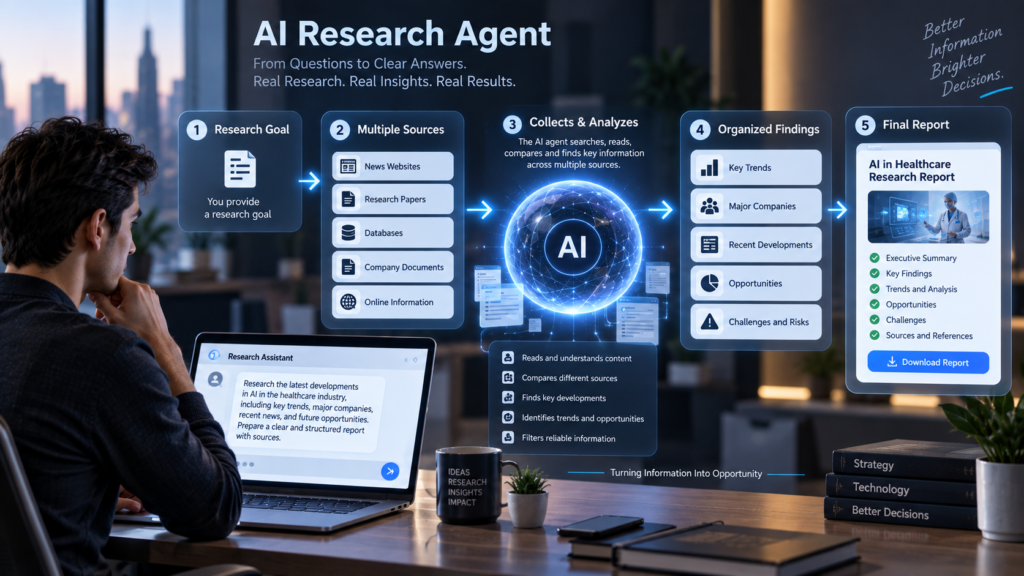
It might:
- First: search for recent information.
- Next: collect information from multiple sources.
- Then: organize the findings by company, technology, pricing, or market development.
- After that: identify important changes.
- Finally: create a structured report.
If its instructions and tools allow it, the agent could even save the report to a document or send it through another connected service. The exact workflow depends on the agent and the tools it has been given.
AI agents vs traditional automation
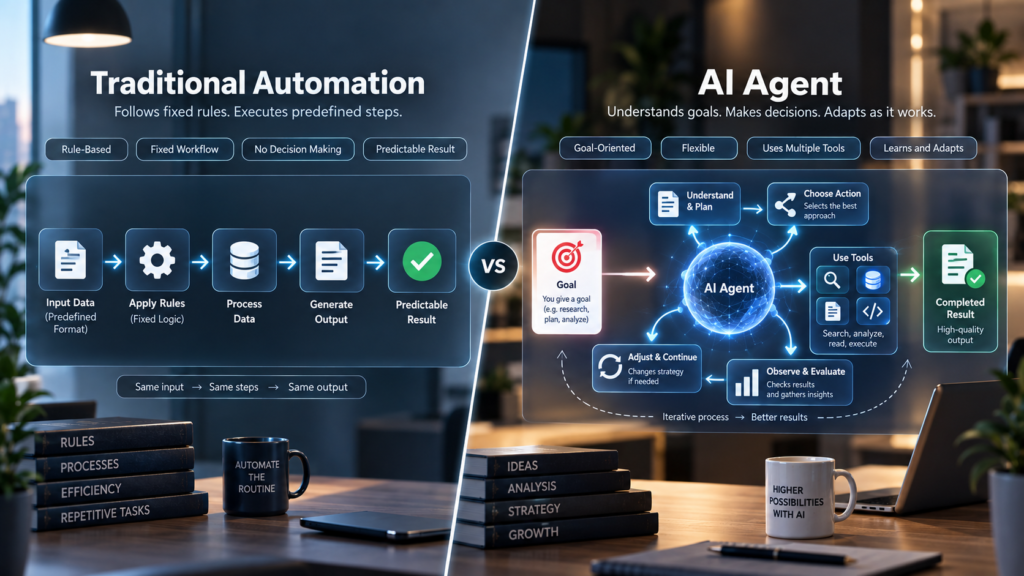
| Aspect | Traditional automation | AI agent |
| How it works | Follows predefined rules and instructions. | Interprets a goal and decides which actions to take. |
| Process | The sequence of steps is usually fixed in advance. | The sequence can change based on the information it finds. |
| Example instruction | “When a customer submits a form, send an email and add the details to a spreadsheet.” | “Handle this customer request and resolve it if possible.” |
| Decision-making | Uses explicit conditions, such as “if this happens, do that.” | Uses an AI model to interpret the request and select an appropriate response or tool. |
| Tool usage | Developers specify which tool or application is used at each step. | The agent may choose whether to search an account system, check a policy database, send a message, or escalate the issue. |
| Handling variation | Works best when inputs and outcomes are predictable. | Can respond to more varied or ambiguous situations. |
| Customer-support example | Take the submitted form, paste it into a spreadsheet, and send a regular confirmation email. | Interpret and understand the customer’s requests, identify account details, read through relevant policies, determine whether an issue can be addressed, and make the necessary adjustments. |
| Main advantage | Reliable, reproducible, and typically testable. | Adaptable and can perform multiple steps in multiple sequences. |
| Main limitation | May not work when a situation isn’t covered by the workflow; may need a new rule. | May misinterpret a request, select the incorrect tool, or act in an inappropriate manner. |
| Best suited for | Stable, repetitive, rule-based processes. | Dynamic tasks that require interpretation, planning, and tool selection. |
Where AI agents can be useful
AI agents are particularly interesting when a task is:
- Multi-step
- Repetitive
- Time-consuming
- Dependent on several sources
- Difficult to handle with a rigid workflow
- Connected to tools or business systems
Potential applications of AI Agents
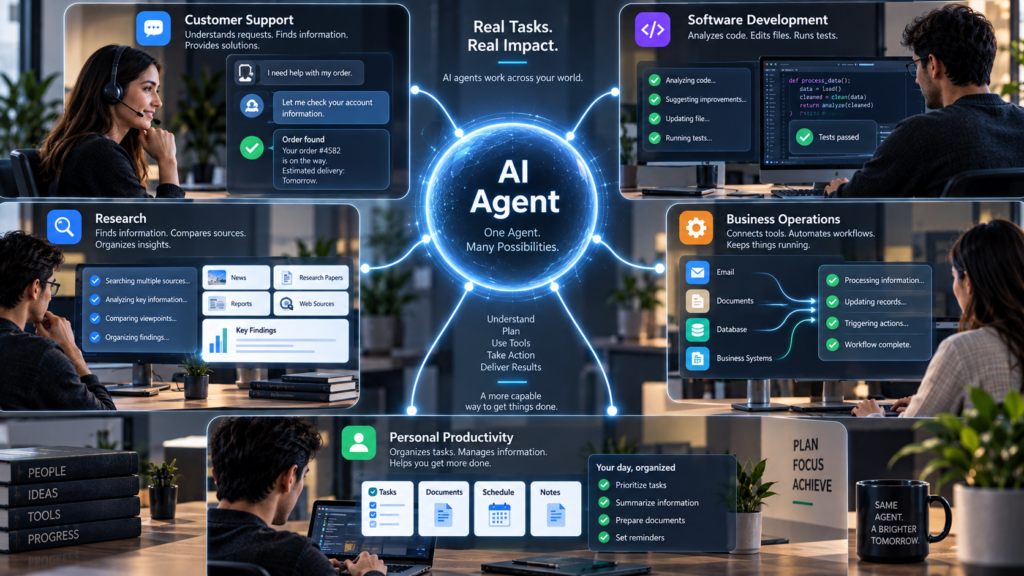
Customer Support
An AI agent can understand a customer’s problem and identify the information needed to help. It may retrieve account details, check company policies, and suggest a suitable solution. For simple requests, it could initiate an action, such as updating a ticket or preparing a refund request, while sensitive actions may require human approval.
Software Development
AI coding agents can inspect code, find bugs, edit files, run tests, and improve their solutions when something fails. Developers can use them to speed up debugging and routine coding tasks.
Research
Research agents can look for information in various sources, compare information, manage information, and produce information reports. They are helpful in obtaining information swiftly, but crucial information requires human verification.
Personal Assistance
An agent could help manage tasks, organize information, prepare documents, or coordinate activities across connected applications. The important point is that the agent isn’t valuable simply because it uses AI. Its usefulness comes from combining reasoning with the ability to access information and take appropriate actions.
Don’t compare an AI agent with an AI worker
AI agents are often mistaken for being autonomous when they are not. The word ‘autonomous’ can give AI agents the impression of independence when they are not. In reality, the vast majority of agents have limits.
Developers can control:
- Which tools the agent can access
- Which data it can see
- What actions require approval
- How many steps it can take
- What happens when something goes wrong
- When the agent must stop
In other words, an agent isn’t necessarily an AI that can do absolutely anything. Its capabilities are determined by the model, instructions, tools, permissions, data, and surrounding software.
Conclussion
But AI agents are redefining the use of AI, moving beyond just getting answers to assigning tasks to AI. Agents can execute intricate tasks that require multiple steps where the human is not directly involved, thanks to reasoning, planning, tool use, and adapting to new information. But they aren’t flawless, and human intervention is still necessary in cases where errors can be significant. However, with the maturing of the technology, AI agents may soon be a much more viable component of our work, research, task automation, and task completion.
FAQs
1. AI agents identical to ChatGPT?
Not necessarily. ChatGPT is an AI tool that can have a conversation, but an AI agent is a broader term and can seek out a goal, utilize tools, and take some action independently. There are some AI products that can also contain agents.
2. Can AI agents distinguish between right and wrong?
Allows multiple steps to be accomplished without constant human intervention, but the level of human involvement is dependent on system design. Still, there are tasks that are important enough that they will have to be approved by humans.
3. Is it reliable to use AI agents?
They are reliable to the extent that the model, tools, instructions, data, safeguards, and task are reliable. There may be errors in the agent’s processing, especially when dealing with multi-step processes, so testing and human control may be essential.