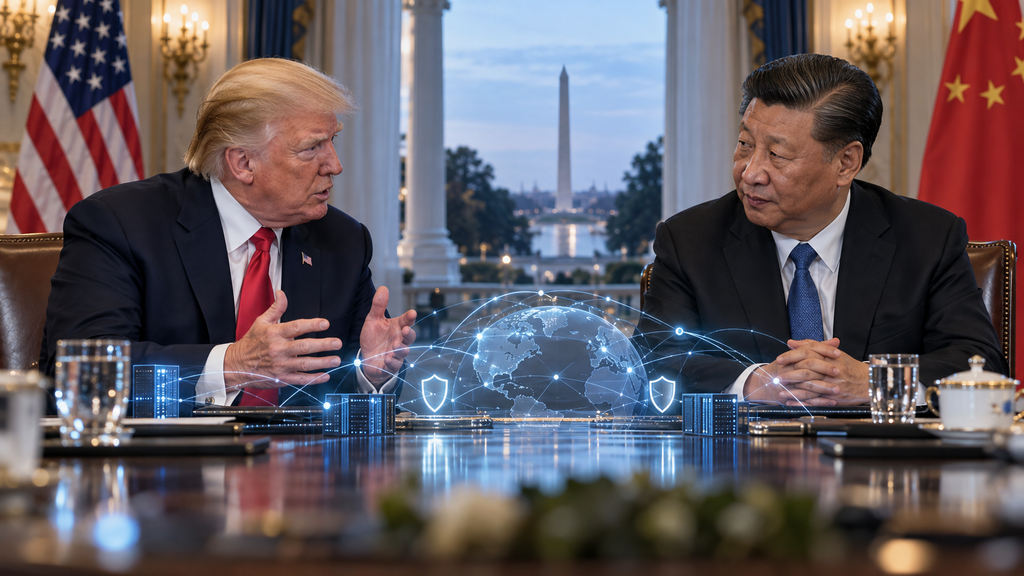
An outcome of the most important AI breakthroughs that came out of the Donald Trump and Xi Jinping summit in Washington, DC, could be anything but a new model, a chip agreement, or a technology plan. Rather, the U.S. and China have agreed to continue their negotiations regarding what to do when artificial intelligence is about to cause a serious crisis.
After Xi met with Trump on September 24, the two countries signed an agreement to open up an AI incident communication channel and laid the groundwork for further discussions of the risks and benefits of AI. China indicated the two countries would keep talking about AI, and the White House characterized the framework as a part of the summit’s results.
The expanded AI conversation from the initial deal
The issue of AI was already becoming a big one before Xi came to Washington.
In advance of the summit, U.S. Treasury Secretary Scott Bessent said the two countries were talking about a “notification mechanism” for national-security events related to AI. The idea was to promote transparency between Washington and Beijing as the two sides push forward with their own AI development efforts.
At the summit, Xi also made it clear to the rest of the world that China’s stance. Both nations have good capabilities in AI, and they should continue to have discussions on the potential dangers and benefits of AI, as well as preventing its misuse and abuse, he said, adding that he will provide China with a detailed list of current concerns regarding the technology. Both countries have good AI capabilities and should discuss further the risks and benefits of AI and how it should not be misused or abused, he said, and that he will share with China a comprehensive list of current concerns related to AI. He further stated that AI should be developed under man’s control.
Trump also stated that artificial intelligence is “the future of humanity” and the U.S. and China must continue to talk and cooperate.
What has happened is that both sides weren’t abandoning the competition; the important point is that neither side was abandoning the competition. The new channel isn’t about replacing that competition, but rather building on it.
AI peace treaty between China and US
This new deal is not the same as a general agreement on the development of AI.
The leaders made no mention of a U.S.-China agreement on an AI safety framework, a ban on frontier AI development, or a pact to limit the U.S.-China competition for new, more powerful systems. The summit resulted in an agreement to start an AI dialogue.
An AI communication channel might come in handy if an advanced AI system leads to a national security incident, if a critical infrastructure malfunction occurs and causes an immediate threat, or if one government thinks another country’s AI activity poses an immediate threat.
However, there are details to consider. It is not known, at present, what sorts of incidents would be suitable for communication, who would do so, and how fast either side would react.

Why This May Be More than Washington and Beijing
What occurs after the cameras depart the summit will ultimately affect the importance of the deal.
The rivalry between the two global giants is unlikely to be replaced by AI. Both nations have compelling reasons to create increasingly powerful AI systems, as well as to defend national security concerns and technological benefits. That makes it a challenging issue: even if two countries are strategic rivals, certain risks of AI could be transboundary.
The bilateral talks also sit alongside wider efforts to develop global AI governance rules.
A communication mechanism provides the two sides the opportunity to discuss those situations before they may escalate. It does not resolve the general conflicts; it is another mechanism through which to do so. If you are a regular user of AI, the changes won’t change right away. Due to the summit, there’s no new product or feature for consumers of AI. The larger picture is the implications of this for AI diplomacy.
It’s been years since AI competition was mainly talked about as a race for better models, chips, data centres and talent. A new element was added at the Xi-Trump meeting – what happens when two competing powers find themselves communicating in the face of problems they can’t solve without each other, and advanced AI is causing the issues? Whether this will prove to be a viable long-term option will depend on the parameters that will be added to it — and whether the channel will be utilized by Washington and Beijing in case of a serious AI incident.