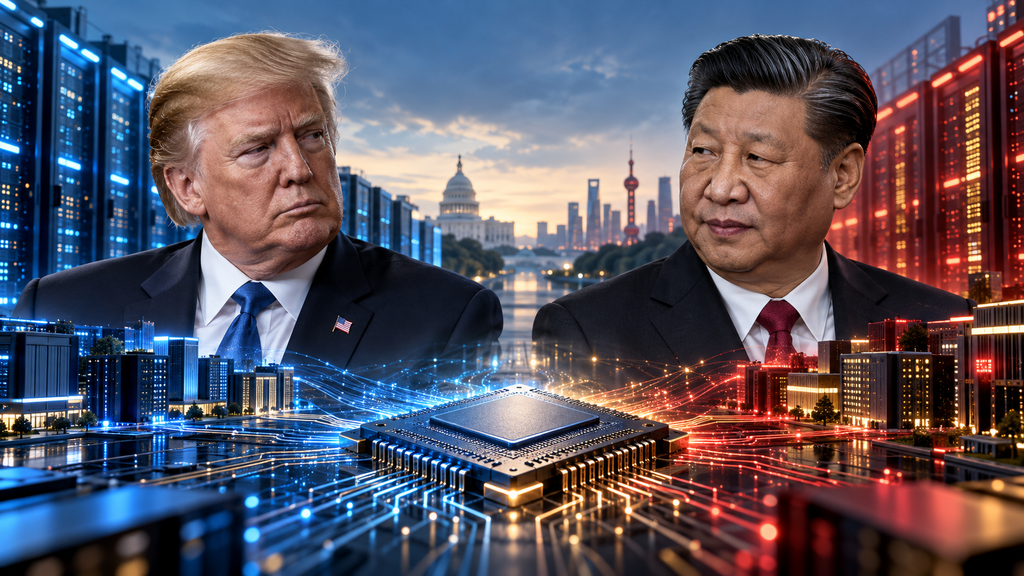
President Donald Trump has said there is no need for closer U.S.-China cooperation in the field of artificial intelligence because it could make it more difficult for American companies to remain competitive with their Chinese rivals in the AI field.
At an event in Washington on Sept. 29, Trump said the U.S. is now ahead of China and other nations with AI and that he would like to stay ahead. He added he had discussed AI with Xi during Xi’s recent visit to Washington.
Trump Wants the AI Race to Stay Competitive
The remarks by Trump follow his meeting with Xi, who discussed artificial intelligence with him days ago.
Both countries have been making more of an economic opportunity and a strategic technology of AI. Still, as AI companies in China rapidly emerge and advance, American firms like OpenAI, Google, Meta and Nvidia are in competition, and the U.S. and China are also having broader squabbles over technology, trade and national security.
Trump’s suggestion is that more collaboration in the field of artificial intelligence would open up American tech advantages. The U.S. is “leading now over China and everyone else” and wants to remain so, he said.
That places the economics of providing competition as the central issue in how the world’s two leading AI powers should engage with AI.

The Complicated Part: They Have Already Agreed to Talk
Cooperation on the safety of AI is different from the development of AI technology.
After the Trump-Xi meeting, the U.S. and China signed a memorandum to hold a bilateral dialogue on AI, which is expected to continue. The two also had a discussion about a communication mechanism for incidents with AI that may impact national security.
This doesn’t rule out the fact that Washington and Beijing may not share the most advanced AI technology, or even be working on developing models together.
Prior to the summit, some tech giants were saying that there should be at least a cooperative approach between the two countries in addressing common AI risks. In the past, OpenAI CEO Sam Altman has proposed that there may be benefits in having common tests and standards for higher-level AI.
Trump has recently said he would prefer to keep America’s technological edge over other nations over other forms of cooperation in the governance of AI.
For AI Companies, the Debate Is More Than Rules
The feud might be important to businesses creating more advanced AI models.
Lawmakers and the public are putting pressure on U.S. technology executives to take action concerning threats associated with the use of powerful AI agents, cybersecurity, and loss of human control over technology. Recent allegations of misuse of their AI agents by OpenAI and Anthropic have raised concerns about the need for more regulation, according to Reuters.
Meanwhile, technology firms have a powerful incentive to strive for ever more powerful systems in a hurry.
This is a tricky policy dilemma that arises: how do governments deal with truly harmful AI threats without stifling innovation, as companies argue?
The situation gets even more complicated if one of the countries involved is the United States’ primary competitor in the field of AI.
The Next AI Talks Will Show How Far Cooperation Goes
Trump’s stance won’t affect the new U.S.-China AI dialogue. Rather, it emphasizes the conflict about the purpose of that talk.
The two governments can discuss other specific issues, like security incidents involving AI, technical risks, and protection measures, without being pushed to co-create AI systems or technologies and give up access to sensitive information. In the past, analysts have proposed that technology competition could be maintained while keeping the discussion within limits of specific risks.
The massive transition can be as simple as learning new tools or changing how they use them, perhaps even in the same platform, for regular AI consumers. For common users, it could involve learning a new tool or simply tweaking their interactions with AI within the same application. The big question is one of the two titans of AI—the world—what it can and cannot agree to.
The second phase of U.S.-China discussions on AI should give more clarity on whether the new conversation is a working, safe one or remains more detached from the race to create the more powerful AI.