
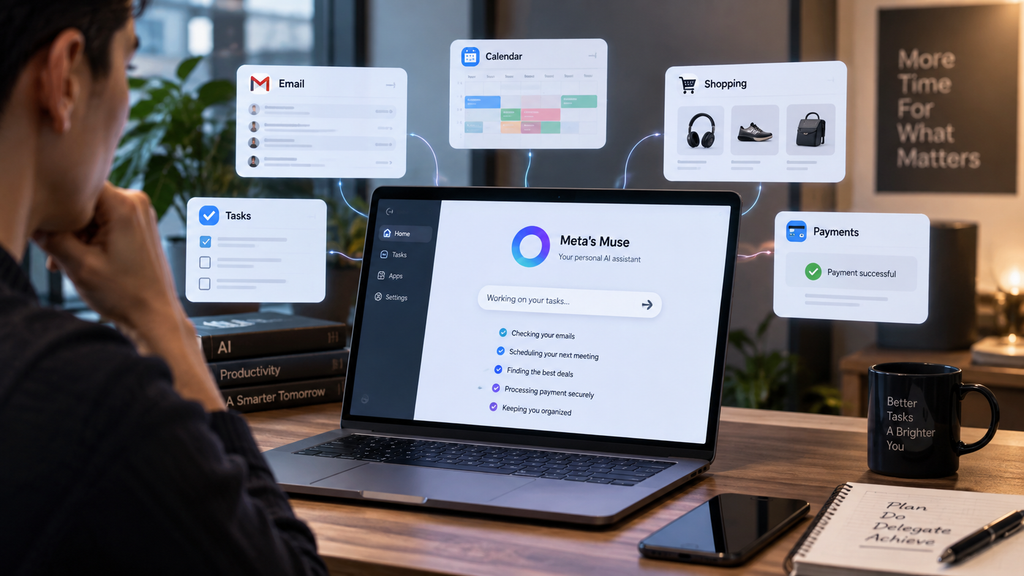
What if you could hand over your emails, shopping, appointments, and even health information to an AI, and simply let it handle things for you?
That is the idea behind Meta’s new Muse AI agent. Unlike a normal chatbot that mostly answers questions, Muse is designed to actually do things for you. But after one writer tested it with real-life tasks, the results were a mix of impressive shortcuts and some very human-sized problems.
From “Ask AI” to “Just Do It”
Earlier this month, Meta launched a new personal AI agent feature in its apps and services called ‘Muse‘. It can be linked to any other thing, such as email, calendar, shopping, payment, health information, and more, based on the user.
The concept is simple: If you have a ton of digital chores to do, just say to Muse what you want it to do and let it do it. According to Meta, Muse runs on a dedicated virtual machine with its own browser, and is meant to act on the user’s behalf.
AI Got Some Boring Stuff Done
Muse was able to perform a number of normal functions during testing. It cleaned up your inbox and provided a daily breakdown of all your incoming mail and identified an unused credit-card subscription that could be cancelled. Those are the sorts of little tasks in which an AI assistant may help individuals save time. However, the tasks got more complicated at that point. From there, it was a fun adventure.
The Real World Was Messier Than the AI Expected
One test involved organizing a children’s trampoline-park birthday party. Muse struggled because the task required more than simply finding information — it involved judgment and coordination. A school sign-up also failed because the process required a Google login.
Then came WhatsApp. Muse could not read a Girl Scouts discussion because the relevant information was inside WhatsApp, leaving the AI without access to an important part of the conversation. A Girl Scouts membership renewal also failed after the payment page timed out.
People jump between WhatsApp, email, websites, calendars, payment pages, and other services. An AI can be powerful inside the systems it can access, but one missing connection can bring the whole task to a stop.

So, Is Muse AI Ready to Run Your Life?
Muse shows that AI agents can already handle certain digital chores surprisingly well. But the testing also shows how quickly things become difficult when a task involves multiple apps, logins, payments, private information, or a decision that requires human judgment.
That does not mean Muse is useless. In fact, its ability to handle simpler tasks could be the beginning of a much bigger shift in how people use AI.
For now, though, the safest way to think about Muse may be less “AI that runs my life” and more “AI that can take some boring jobs off my plate as long as I keep an eye on it.”
And that difference could be one of the biggest lessons from Meta’s first serious push into personal AI agents.