
The UK is preparing a new front against AI-powered disinformation while pushing for international rules governing the development of advanced artificial intelligence.
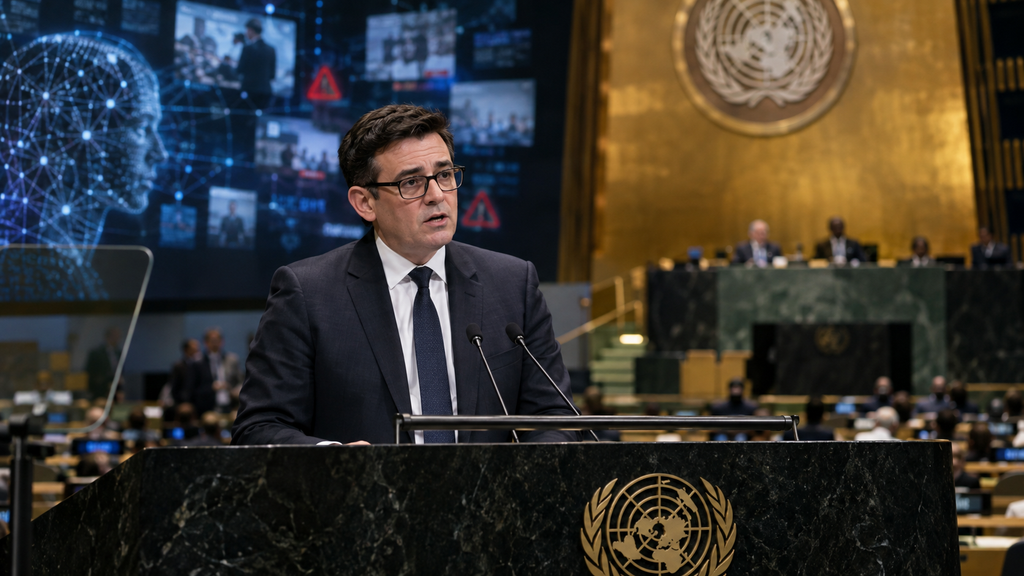
Prime Minister Andy Burnham announced both moves during his first speech to the United Nations General Assembly in New York on September 22, saying the UK wants to use its position between major powers to help shape how AI is developed and how hostile information campaigns are confronted.
The announcement puts two rapidly developing issues together: the growing use of AI to create and spread misleading content, and the lack of a single international framework for managing increasingly capable AI systems.
UK’s New Information Centre against Attacks
Burnham said security chiefs have been tasked with beginning work on a National Centre for Information Defence.
The centre is intended to detect, attribute and disrupt hostile state information attacks. It is expected to bring together expertise from intelligence agencies, government departments, law enforcement and social media companies. The government says AI-generated deepfakes and other technologies could make existing information threats harder to detect and potentially increase their reach.
Russia was a major focus of Burnham’s speech. He accused Russian agencies of using bots, fake websites, falsified newspaper articles and forged branding linked to 28 British organisations, including universities and the BBC.
The UK has evidence that Russia attempted to interfere in the 2019 general election, and she is estimating that it costs about £1.3 billion a year for the Russian state to manipulate information, Burnham added. Russia has denied such accusations, having earlier referred to the UK’s allegations as groundless.
There’s much less to do than simply recognizing a blatant fake news story and more to do than identifying coordinated campaigns that may include fake websites, social media accounts, manipulated images and AI-generated content.
Burnham Wants AI Rules That Cross Borders
The second part of the announcement moves from information warfare to the wider question of AI governance.
Burnham described advanced “Frontier AI” as both a major opportunity and a source of risk. He said the UK would work toward “a single set of global principles and standards” covering issues including transparency, access to AI models and safe development.
The UK plans to make AI a central issue during its G20 presidency in 2027, when the group is due to meet in Manchester.
Burnham also pointed to the UK’s AI Security Institute, which tests advanced AI models for safety, and said fundamental decisions about AI should ultimately be made by elected governments rather than left entirely to technology companies.
That proposal faces a significant international challenge. The United States and China are among the most important countries in advanced AI development, and both have taken different approaches to international AI oversight. US President Donald Trump told the UN earlier that the US would reject an international “scheme” to control AI, highlighting the difficulty of reaching one global framework.

The Hard Part Starts After the Announcement
The direction has been set by the UK, but there are many details yet to be determined.
The government has not yet given a full explanation of the legal arrangements, oversight mechanisms or rules for data-sharing for the new information centre. Those questions will be important because intelligence information, social-media data and decisions on whether online activity is part of a coordinated activity can all be factors in determining if there is foreign influence.
There is also a separate question over how far AI safety testing should go. Current testing by the UK’s AI Security Institute is voluntary, while some international proposals call for mandatory testing of powerful frontier models before release.
For now, Burnham’s announcement establishes a clear direction: the UK wants to treat AI not only as an economic technology, but also as a security and international-governance issue. The next test will be whether Britain can turn those proposals into arrangements that other major AI powers are willing to support.