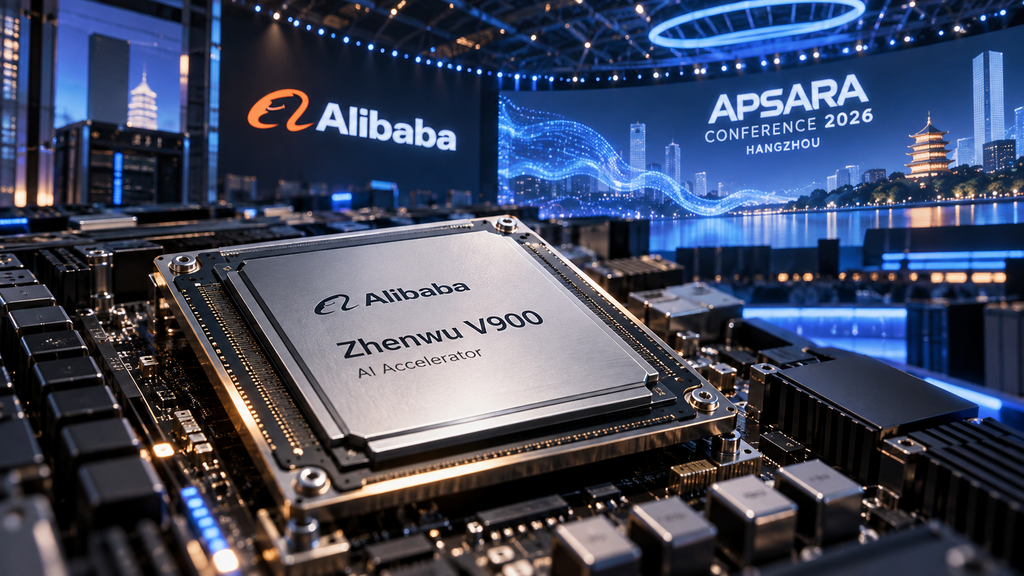
Alibaba is also taking a much greater gamble on artificial intelligence. Chinese tech giant unveiled a new AI chip and outlined plans to create AI models with a potential of 10 trillion parameters at its annual Apsara Conference on 22nd September in Hangzhou. The announcements reveal that Alibaba isn’t just looking to develop more effective AI software. It’s also working on the chips and cloud setups that enable the models to be trained and used.
Alibaba’s New AI Chip Is Built for the Next AI Race
The highlight of the hardware announcement is the “Zhenwu V900 chip” developed by T-Head of Alibaba’s semiconductor business.
It is the most powerful AI chip in China and has three times the power of the previous-generation Zhenwu M890. Alibaba CEO Eddie Wu said the chip is able to be clustered together to form larger groups with the ability to meet the vast computing needs of the next generation of AI models.
It’s important because AI models are not software products. They are very costly to train and to operate. Alibaba is hoping the V900 will go into mass production in early 2027, according to Sources.u
Alibaba’s 10 Trillion-Parameter Ambition
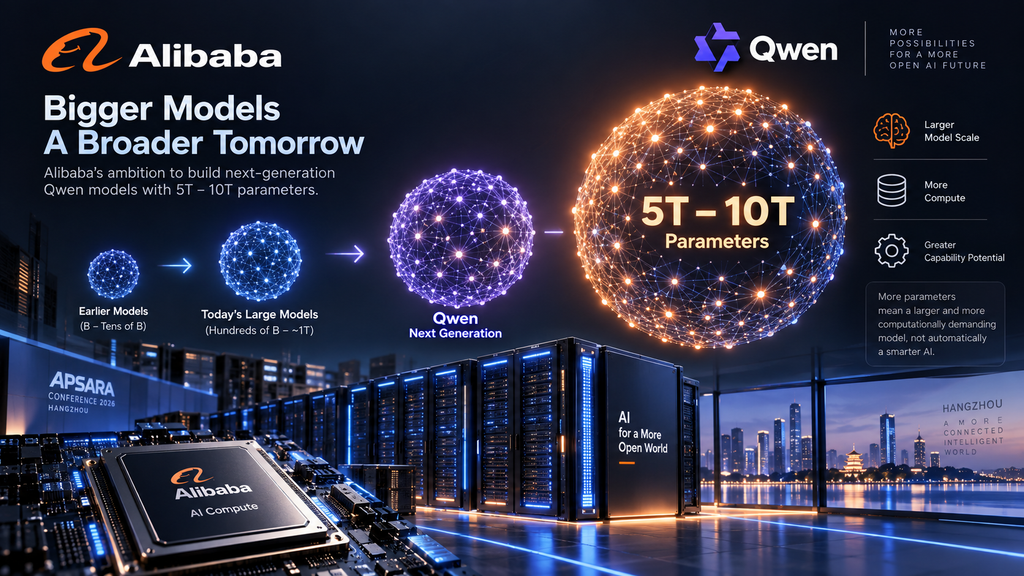
When coupled with Alibaba’s plans for its Qwen AI family, the hardware announcement is all the more fascinating. Alibaba states that it intends to train future models to have 5T to 10T parameters. It currently has a flagship model called Qwen3.8-Max with 2.4 trillion parameters; the planned systems could be several times larger in terms of parameters. Parameters can be thought of as the adjustable numbers that an AI model learns when it is trained. Additional parameters can be used to increase the capacity, but more parameters do not necessarily lead to a more intelligent and useful model.
According to Alibaba, it has already begun training its next-generation Qwen 4, and plans to scale up the model to 5 trillion to 10 trillion in the future with the help of Qwen 4.5 and Qwen 5. The company’s ultimate aim is to create systems that can perform increasingly complex and longer-running tasks as it pursues what it calls ‘artificial superintelligence’.
Alibaba Wants to Control the Whole AI Stack
There’s one other aspect of the news that may be hard to catch. Alibaba is creating a lot more than just models and chips. The company’s desire is to have massive cloud infrastructure behind it. Alibaba’s goal is to boost its data-center capacity in the world to 20 gigawatts by 2032, indicating that the company believes AI computing needs will continue to increase.
Basically, Alibaba wants to create the entire pipeline from AI models through AI chips to data centers to cloud services. The strategy may help ease the company’s reliance on other hardware and make its AI technology available to its customers via Alibaba Cloud.
Whether Alibaba’s ambition scales
The news comes on the heels of China’s tech giants working to build their own AI chips and chipmaking facilities, while the U.S. is banning some of its most potent chips and chipmaking equipment. Other Chinese firms are also trying to boost domestic alternatives, with Huawei recently increasing its R&D spending on home-made phones. Other Chinese firms are also trying to bolster domestic alternatives, while Huawei recently boosted research and development on home-made phones.
Creating a high-tech AI chip is just the beginning, however. Creating those chips on a large scale, building up enough computing infrastructure, as well as creating models that work well in real-world applications are all different challenges.
To the average consumer, its first effect might not be a new chip that they can purchase. The greater shift might ultimately manifest itself in the AI tools and cloud services they use, with more powerful models being able to perform more complex duties.
Alibaba’s goals are lofty, but many of them are still yet to be achieved and unlikely to be technology that’s easily accessible at these scales before the company gets to them. Next on the list will be whether the Zhenwu hardware can go into mass production, and whether subsequent models of Qwen can translate the massive amounts of parameters into improvements for users.
At the moment, Alibaba has just one thing to say about its AI strategy: It’s not just about developing chatbots. It’s seeking to develop the computing infrastructure of the next generation of AI as well.