
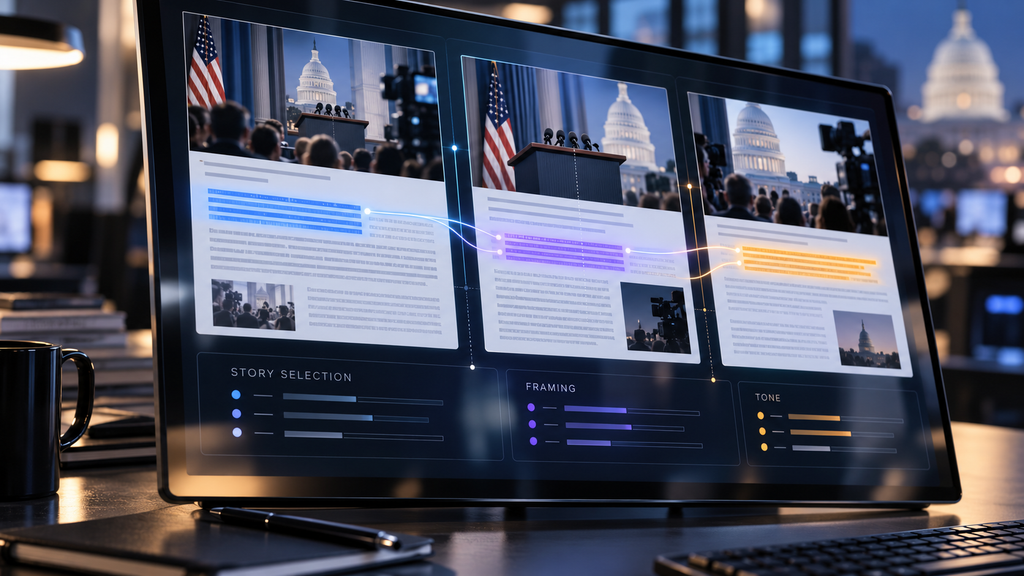
Artificial intelligence is providing voters with a fresh perspective that enables them to investigate the content they read in news media, but this isn’t about suggesting the media outlet they should believe. A team at the University of Pennsylvania has come up with a framework to use AI to uncover the selection, presentation, and framing of political news at news outlets. The project, called the Media Bias Detector, might be useful for readers to compare the coverage of an event and see how editorial decisions affect their perception of the world.
With the United States fast approaching its mid-term elections in November 2026, voters will be inundated with political news, varying explanations, and information online. The system does not take a stance of ‘biased’ or ‘unbiased’ on a whole publication, but rather looks at patterns in coverage and provides readers with more information to form their own opinions.
AI transcends political jargon to give a clearer picture of news sources
Developed by the Computational Social Science Lab, a project of Penn Engineering, the Wharton School and the Annenberg School for Communication, the Media Bias Detector was launched in 2024. The project uses an AI system to gather news content, and then uses large language models, a subset of AI systems that are designed to interpret and understand the news content in almost real time, to analyse and interpret it, and to review articles from a variety of publishers.
Among other characteristics, the team’s most recent study, published in Science Advances, analyzes the political orientation of articles, tone, whether the article is a news article or opinion piece, major events discussed, and the people or facts covered in the discussion. In addition, they’ve made available a data set of over 140,000 articles during the 2024 presidential election in the United States.
But this raises a troublesome issue: when it comes to news, how can anyone know if it is biased, given that there is no standard definition of what the “neutral” version of an event might be?
Instead of giving a single political classification to each publisher, the researchers look at “quantifiable variations in the selection and presentation of stories”. The political hawkishness or dovishness of a publication might depend on the topic of the discussion.

The largest bias might be the one that never occurs to anybody
This problem is captured in the Penn research’s eye-catching result: For the 2024 U.S. presidential election, the news media coverage was four times as extensive of the presidential race—including who was ahead and who was behind—than the combined extent of their coverage of all U.S. presidential policy issues.
It is important because voters are seeking more than information on the popularity of candidates. They might also like to get some information on health care, immigration, education, taxes, and any topics that impact their life. If attention is focused on the competition for the election, the reader might not get the attention they deserve for the policy aspects of the election.
Patterns can be explored in publishers’ and event-specific contexts, with the help of the researchers’ framework. It can also assess who is being covered by politicians, who is being quoted by the experts, and how the same development is being portrayed in various media.
This is a chance for regular news readers to delve deeper into a story and consider what data is being highlighted — and what might be missing in the mix.
Reading involves critical thinking, which is important for readers
Media Bias Detector is a helpful tool to look at news coverage, but is not a definitive test of truth or neutrality. Measurable factors are political lean, tone, and story selection. The accuracy, fairness, and/or misleading nature of a particular report may need additional evidence and context.
AI analysis can also be wrong when it comes to understanding sarcasm or more complicated political arguments. It should be used to provide clues and a direction for further investigation, not judgments on a publication.
It is easy for voters and the general public of news consumers to know what to do: look for key events covered and look below the headline; when possible, look at original documents and, when possible, tell the difference between reporting and commentary.
With the upcoming 2026 US Midterm Elections, these types of resources might help people understand what the news is saying, as well as the impact different news choices have on their information. It is not about letting AI influence the beliefs of the voters. It is to provide them with greater information to help in their decision-making.