Research may be a very frustrating process. You’ve found a very interesting response, and you need to locate the source of the information, determine whether the source is credible and trusted, and interpret the information. Perplexity and ChatGPT can help with these problems, albeit in different ways. The essence of Perplexity is identifying the material on the web and determining its source. In addition to providing answers, ChatGPT can evaluate evidence, understand complex ideas, and even generate a report, article, or steps to take based on the evidence it finds.
This can be higher than both, but becomes more apparent when looking at their use. If you had to study one of the following subjects in 2026 which would it be? Let’s learn how they search and utilize sources, their trustworthiness, how they research and how much they cost you to meet your needs.
Which One is BEST?
For most research first tasks, use Perplexity. It is supposed to answer inquiries by referencing the source of the information in the same line, and to enable the user to easily trace back a claim to its source – by default on the Internet. It has a Pro plan with more in-depth research, higher levels of data sources, model selection, and file analysis.
To be specific, in terms of research, ChatGPT could prove to be more effective, at least at the beginning. Useful for a report, a spreadsheet analysis, a presentation outline, coding, or a lengthy project process. It offers features such as deep research, projects, custom GPTs, data analysis, and extensive productivity capabilities.
| Choose | If your main job is… |
| Perplexity | Finding current sources, verifying claims, researching a topic quickly, and keeping citations visible |
| ChatGPT | Researching, then drafting, analyzing data, coding, brainstorming, and iterating in one workspace |
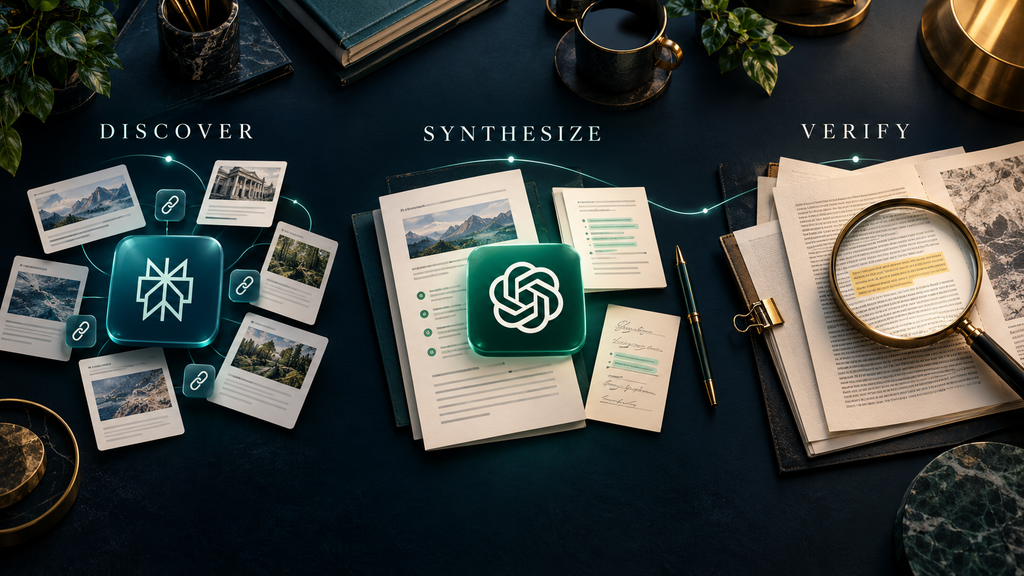
| Both | Using Perplexity for source discovery and ChatGPT for synthesis, drafting, and execution |
Perplexity

Perplexity is an AI-powered answer engine that revolves around web search. It isn’t just a chatbot; it’s a bot that answers a question by synthesizing information and citing the sources that are used.
The free Standard tier offers essentially unlimited basic searches, a relatively small number of Pro Searches, basic file uploads, and model selection via Perplexity. Perplexity Pro doubles down on those limits and also provides deep research, advanced AI models and model options, enhanced file/photo uploads, image and video generation, and premium data sources like PitchBook and Statista.
Main strengths
- Research is not an optional practice; it’s the default practice.
- It speeds up the process of checking sources by using in-line citations.
- Pro can process queries through models like ChatGPT, Gemini, Claude, or NVIDIA Nemotron.
- Preparing premium data sources brings value to finance, market, and business research.
- It has a user-friendly interface that promotes brief research sessions with questions.
Main limitations
- It’s not the same as ChatGPT since it’s not a one-stop creation space.
- Plan limits apply to advanced research and files.
- While citations help to make things transparent, they do not take the place of assessing source quality.
ChatGPT

ChatGPT is OpenAI’s all-purpose AI assistant. It has conversation, web search, deep research, file uploads, data analysis, image generation, voice, projects, custom GPTs, and developer tools like Codex, and will be further enhanced in 2026.
All the features of the free plan include unlimited text chats with GPT-6, limited ability to upload, create images, voice chats, deep research, memory, and Codex. The new ChatGPT Plus introduces enhanced reasoning capabilities, greater deep learning capacity, more uploads and memory, Projects, calendar functionality, and custom GPTs, as well as an expanded Codex. ChatGPT Pro is geared towards research and coding, offering maximum deep research, larger context, and more advanced model access.
Main strengths
- With deep research, reports with citations and source links can be generated.
- The file analysis and data analysis features are closely linked to the chat conversations.
- Supporting ongoing work with projects, memory, scheduled tasks, and custom GPTs.
- A wide range of use cases for writing, coding, business, and education.
Main limitations
- There is search on the web and citations, but the focus in the discovery of sources is less prominent than in Perplexity.
- The top research features are available in paid plans.
- It can lack specificity in its scope, resulting in less efficiency when doing a “find and cite sources” assignment.
Feature Comparison
| Feature | Perplexity | ChatGPT |
| Developer | Perplexity | OpenAI |
| Core strength | Web research with citations | General AI assistant and work workspace |
| Free plan | Basic searches, limited Pro Searches, limited file uploads | Unlimited text chats with GPT-6, limited uploads, deep research, image creation, voice, memory, and Codex |
| Entry paid plan | Pro: $17/month billed annually | Plus: $20/month |
| Premium plan | Max: $167/month billed annually | Pro: from a higher monthly price, with expanded research and context help. |
| Web search | Central to the product; answers include inline citations | Available across plans; deep research expands on paid tiers |
| Citations | Inline citations are a core feature | Provided with search and deep research outputs |
| Deep research | Available, with higher limits on paid plans | Limited on Free/Go; expanded on Plus and maximum on Pro |
| File analysis | Supported, with higher upload limits on paid plans | Supported, with expanded uploads and analysis on paid plans |
| Image generation | Available on paid plans | Available, with more advanced generation on paid tiers |
| Video generation | Available on paid plans | Not positioned as a core ChatGPT research feature on the current pricing page |
| Coding | Can use advanced models and create files/apps, but not its primary identity | Stronger overall coding ecosystem, including Codex and developer-oriented features |
| Best for | Source-backed research and fast answers | Research plus production work |
How the Tools Compare Based on Available Evidence
For this to be fair and hands-on, the same prompts, plan, date, and settings would need to be utilized across both products. This was not done for this article, and as such, no fake test results are included.
So, as a rule, it seems that this pattern would be:
- Answering a simple factual question: Perplexity is probably more efficient since it is creating the citations in the answer.
- Current Events Briefing: Perplexity is probably more suited to an initial sourcing approach.
- Long report: A deep dive with ChatGPT will be better for generating a more structured and editable report.
- Data Analysis and spreadsheet integrations: With the ability to incorporate data analysis and spreadsheet integrations, ChatGPT is better suited for this aspect.
- Technical research followed by code: ChatGPT is a better all-in-one.
Which would be more useful for someone who uses it on a daily basis?
The more useful it is to most users, the more it will be designed to ease searching the web and provide citations that enable users to check the source from which it has been obtained. Useful for students, researchers, writers, and professionals to verify facts, compare sources, and research a topic to help them make a decision.
ChatGPT is most useful when a user wants to take the information and use it to take an action – in the case of the above, generating an article, analysing a spreadsheet, writing a report, brainstorming ideas, or creating a project. In summary: Use Perplexity to research or confirm your research, and use ChatGPT to draft your research from the results you have found in Perplexity; using both together can yield the best results.
So which AI Tool to use?
Consider Perplexity if:
- Need a more budget-friendly dedicated research subscription?
- Need to use several documents/sources and must track claims.
- Select a research tool that is focused and not an AI workspace.
Use ChatGPT when:
- Research and write, analyse, code/construct something.
- Want in-depth analysis, which can be correlated to documents, spreadsheets, projects, and custom GPTs.
- Desperate for a more extensive productivity ecosystem.
- Complete a long piece of work (over one question).
Choose both if you:
- Develop content, conduct professional research, or make a decision based on facts.
- Wish for Perplexity to discover and verify, and ChatGPT to synthesize and execute.
- Should reduce reliance on the approach to searching or the sources used by a single AI.
Conclusion
The key difference between Perplexity and ChatGPT is that, after the question, ChatGPT will provide an answer, while Perplexity will show results. While ChatGPT can assist the user in diving deeper and better understanding the evidence, Perplexity can help the user to research information and trace it back to its sources to make the information usable for them.
If you’re just beginning to learn how to read the news, you should start learning about how to find reliable sources and fact check it with Perplexity. A more flexible place than ChatGPT to find ideas and analyse documents: research articles, reports, presentations. It’s not necessary to make just one selection. With the use of Perplexity, one can find out who the source of the information is, analyse it with ChatGPT, and confirm its importance with the source.
The best research tool, however, is not the one that will give the quickest answer to the question. It’s the one that can assist you with finding reliable evidence, understanding its significance, and making a logical conclusion.
FAQs About Perplexity vs ChatGPT
1. Comparison: functionality of ChatGPT and Perplexity?
Perplexity can be more useful for web research as it offers sources in addition to its answers. ChatGPT can also use the internet to find information and assist with research analysis, information explanations, and structuring research outcomes.
2. Can ChatGPT be more accurate than Perplexity?
None of the tools are invariably more accurate. Either can give false or misleading information. In many situations, Perplexity’s source links allow you to easily verify information; however, for important information or statements, always check with reliable, original sources.
3. Do I need to pay for ChatGPT or Perplexity?
Yes, both have plans that are free to use and provide access to the basic features. However, there may be restrictions on usage and access to the more sophisticated models or features. Visit their official websites for the most up-to-date information about their plan.